This post is my solution to the problem I outlined here about how the pandemic has drastically changed hiring practices.
A solution to aggregate recent data with established wisdom to create and edit job listings can be done in several ways. For example, prioritizing newer information over older is insufficient because some insights are timeless, such as the fact that years of experience is usually valuable. Furthermore, combining data from several sources is painstaking work that often takes up entire data science and engineering teams.
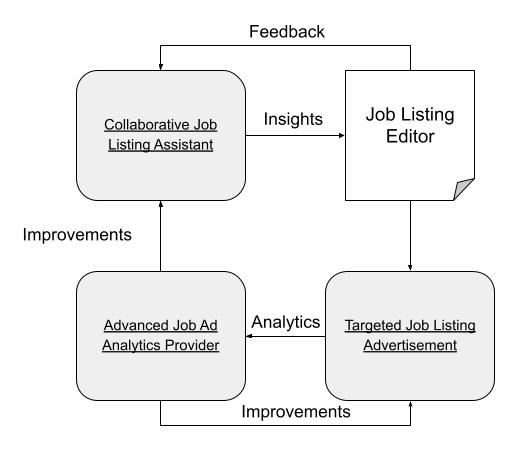
Some of this work can be automated with artificial intelligence. However, using complicated statistical models like deep neural networks to shortcut this process is not only not interpretable, but is also very expensive to train, with training a single model polluting more than five cars throughout their entire lifetimes. Instead, an interpretable assistant is needed to recommend data’s insights and its reasoning, which gets better over time by collaborating with the human user. To implement these ideas, I will create a Collaborative Job Listing Assistant.
To post relevant job listings across the web, the traditional approach of duplicating a job listing across multiple job boards requires formatting to different formats required by each board. Then, once posted to each board, it’s difficult to update unless all postings are centrally tracked — requiring a whole other team to manage. Even in that case, though, such a team would not have any guidance for how to update the listings.
Instead, an approach is needed that can take advantage of a simple job listing format and be posted around the web. To accomplish this, I will use online advertisements as inspiration, with more of a focus on Google search ads than irrelevant banner ads. Given that, the ads will be targeted to people’s actual needs, rather than trying to steal their attention from their current task.
However, since the ads will be hosted on other websites, additional metadata about the websites will be collected and used to target the job ads. Based on the types of jobs being advertised, other common websites for people in these industries will be used. For example, job ads on Hacker News, Slashdot, or Stack Overflow could be target to software engineers. The resulting component will be called Targeted Job Listing Advertisements.
Using this advertisement system, a solution to track the performance of job listings with actionable metrics seems relatively straightforward. However, listings on job boards usually do not have analytics, at least ones that are actionable. Instead, they more likely provide simple analytics like the number of views, clicks, and applications submitted from your job ad. Such analytics will illustrate a very simple conversion funnel, but nothing more.
It would be better to know more advanced analytics, such as time spent on a job listing, time spent on other companies’ listings, which ones candidates apply to, and the properties of those listings and companies. Therefore, links in job ads will go to a separate website that tracks these more advanced analytics. The resulting component will be the Advanced Job Ad Analytics Provider, and with it employers will be able to improve their job listings and the advertisements across the web.
I am working on addressing this problem right now. For more information, feel free to email me at bob@datagotchi.net.
 Datagotchi Labs