
Counteroffer

My Solution to Using Leverage to Make Demands from Employers

To make demands from employers, either before applying for a job or after a yearly performance review at a job, I have found in my research that the missing piece keeping employers from responding, and responding well, is illustrating your leverage

To show leverage before getting a job, a solution must combine weighted candidate preferences with filterable, anonymous experiences mapped to job requirements. For candidate preferences, many of them are often discussed on an initial “short call” with a recruiter. This call often ends up not being as short as promised, and being stressful and relatively useless for the candidate. Instead, as much of this information as possible should be available to the employer before any calls occur, if any still need to happen at all. 

To weight these preferences, the most obvious of the options is to put the most important ones first. However, this approach does not support changes in the order based on the type of job or employer. Also, to support that functionality, specifying orders based on an infinite number of options is not practical. Rather than linking preferences to all possible desired job types and employer types, they should be linked to a smaller set of options. Creating static versions, or themes, for a subset of all possibilities still does not enable adjusting them to slight or drastic changes based on interactions with an employer. Therefore, I propose linking the preferences to pre-specified portfolio themes that can be easily adjusted on-the-fly to more closely match a job opportunity or employer’s preference. 

Experiences are often grouped together to best match a job listing to which a candidate is applying in a static resume. This has to be adapted for every job listing they apply to, often even if they are the same job type and in the same industry. Instead, a live web page of their experiences should be used so employers can identify their strengths and weaknesses across any or all relevant attributes. 

Furthermore, such a live web page should show their current experience(s), even if they aren’t necessarily related to an employer’s particular job, so it’s clearer that why they may not be looking for a job. If an employer can filter by particular attributes, that would enable them to both see their current job for this reason, and to determine the candidate’s fit without having to look deeply through every experience. 

To anonymize the experiences to reduce or eliminate bias for (or against) particular employers, just doing so would not work because then the context of their job would also be removed. Therefore, some amount of context should be included, such as the company’s industry, approximate size, and status as publicly traded or private. For example, a “large private tech company,” a “publicly-traded energy company,” or “a series D health tech startup” may suffice instead of company names. 

When put together, particular candidate preferences and particular work experiences could distract from the rest of the page. To address this problem, one section of the page should be hidden when the other section is in view. However, doing this could cause the employer to forget something from the other section. Therefore, pinning items from each section should be supported so they are shown when viewing the other section. For example, a candidate preference to work remotely may be pinned while looking at their experiences, to see if their qualifications outweigh this perceived downside by many managers. Similarly, the amount of time a candidate has in a particular technology or skill could be pinned while looking at their preferences, so that their qualifications may outweigh their need for visa sponsorship. 

The resulting component will be called the Dynamically-Targeted Online Portfolio. It will by default be shown as a web page, but could also be rendered in a mobile application to support both viewing by employers on-the-go as well as candidates making minor edits on their phone. 

To show leverage while having a job, a solution must chronologically show job qualifications and performance weighted by coworkers all in the context of union leverage

To start, an employee’s previous qualifications that got them the job should be shown because those qualifications should still be relevant, unless their job changes changed substantially since they were hired. Then that can be combined with their current year’s performance by mapping their year’s goals to their successes (e.g., deliverables, meetings), and confirm these claims by weighting them with upvotes from their coworkers. To integrate these two types of information, qualifications should be shown on the same timeline as this year’s job performance. To rank performance metrics in both contexts, a simple binary system could be used to measure subjective successes or failures. However, that would not take into account the upvotes from coworkers. On the other hand, upvote counts would then make qualifications look like they only received a single upvote. 

To equate these two types of information, I propose using the percentage of coworkers that upvoted a success and the binary qualifications, thus making both of them between 0 and 1. Even then, though, not all coworkers know about an employee’s performance in each category. Therefore, this percentage should be weighted by coworkers that respond, even if they respond that they do not know enough to upvote. For coworkers that respond that the employee did not perform well, the net percentage (i.e., (upvotes – downvotes)/total votes) should be used. Then, these can be supplemented with their successes from previous years at this job, if applicable, to show how they have continued to perform well, or, even better, improved. 

With this greater amount of chronological data, dimensions will likely change over time – not only because a job’s performance metrics change after a candidate is hired, but also because they changes year-over-year. Both the previous metrics and the current metrics should be shown to show that they have changed. Presumably the current ones should be more visually salient, though. One option is to hide old metrics by default, but this would not show what they changed from. Another option is to gray them out (i.e., make them look “disabled”) or blur them. This would be better than hiding them, but indicating why they changed would be best – for example, showing an icon over them that indicates they are for more junior employees and thus not directly measured in more senior ones anymore, or they are no longer relevant.

Finally, union strength will show that, even if they are not necessarily improving over time, they deserve to be given support from from their employer to enable them to do so. Union strength itself can be shown in the form of number of members in the union and/or percentage of the company’s employees in a that job area. However, that alone is likely to be interpreted as an act of aggression toward the employer, rather than something more collaborative like needing support because they are going through hard times. Therefore, this information should maybe be shown implicitly, though not so much that it is not noticed for what it is. For example, changing the background or foreground color of this year’s performance metrics to match the union’s logo is probably too implicit to be noticed by the employer, while showing the union logo itself on this view might be too explicit. Therefore, I propose an explicit indication that does not, at least at first, indicate it is about union membership. For example, showing a ‘?’ icon above either a less-good, or reduced compared to last year, job performance metric that explains more details in a popup. 

To combine all of these aspects together, I will create a Chronological Employee Performance Meter. Its main view will be a time series chart, starting with the on the left with the employee’s predicted value when they were hired using data from the Dynamically-Targeted Online Portfolio component above – i.e., it will show job requirements versus tags in the portfolio. It will then show the employee’s successes, both for this year and past years the employee has been at this company. For “skilled” or knowledge workers, the Y values of this chart can and should be quantitative measures of the successes weighted by their coworkers in the form of yearly reviews. For “unskilled” or manual labor workers, their success claims can perhaps be confirmed or denied by their manager. Either way, their past and current year’s reviews should be supplemented with commitments from their manager to help them improve in the aspects of their job that they underperformed in. Finally, it will link the underperforming notes and commitments from their manager to improve on them to their union strength, if applicable, to give their manager a greater incentive to keep them rather than fire them and lose all of their union members at the same time. For job improvements due to legitimate critical reviews, the union strength communicates that their manager should collaborate with them to improve their value to the company in the best possible ways. For life circumstances that may cause employees to underperform intermittently, the union strength communicates that their manager should support them because they are a human and worthy of it. 

To contextualize questions and demands with importance and leverage from both good qualifications/performance as well as human needs, both types of context need to always be shown, and should be easily-identified as different. 

To show questions and demands, a user interface (UI) that is familiar to the employer should be used, ideally in the same form for those employed in the company as well as those who may be a good fit for a job in the company. Therefore, I will use a survey UI that frames demands as questions on whether or not they can satisfy the demands. Furthermore, I will make their high importance clear, along with additional leverage. 

To contextualize the questions with importance, putting them in a particular order might work. However, like with candidate preferences above, that does not support changes based on different types of context. Therefore, the order of questions should be tied to known types of context, such as high or low expectations of an employer’s reception to being asked the questions. For example, a raging job market for software engineers may suggest that the candidate has additional leverage over employers, so they may choose to put questions about salary and working from home first in the survey. On the other hand, an employer who has not recognized a union yet is unlikely to respond well to some types of demands, so an employee may choose to not make them for now. To support both of these types of situations – order changes and removal of questions – survey “themes” should be created beforehand, and should also be easily changeable depending on the situation.

To contextualize the questions with leverage, the above ideas for how to illustrate different types leverage should be combined with the survey UI. 

For relevant experiences that give one leverage for a job, mapping them directly onto the job requirements is a good first step mentioned above. To show this leverage with the survey questions, though, this information should be used in an easily-understandable format. For example, the percentage of job requirements that are satisfied from past experiences could be shown in a horizontal bar above the survey. However, that does not show the number of experiences that fit individual requirements. A better visualization for that would be a stacked bar chart that splits the bar into sections for each requirement and colors them based on how many instances in the candidate’s past experiences. 

For good performance reviews that give one leverage because they are an especially-valuable employee, the idea above is to show timeline – i.e., a line chart with the X axis indicating time. For a question survey, putting it above the survey UI like the stacked bar for candidates would be a good use of space, and would make the survey UI more consistent for employers who see it for both new candidates and existing employees. 

For union strength leverage, the above idea is to show indications of poor performance on the timeline with explanations on how union strength suggests the manager should work with the employee to address them. Fortunately, this can be used directly with the timeline shown above the survey UI discussed in the previous paragraph. 

Finally, once an employer answers the questions in the survey, this information should be used for the benefit of the candidate or employee. If the question response is deemed of high-enough quality (whether or it is a possible or negative response), it should be usable in a variety of ways – either in its raw form, or to trigger other actions. To support the latter use, a response outcome model of some sort should be created along with the question, like the If-This-Then-That (IFTTT) tool. For example, if the question is a demand with a negative response, then that information can be immediately sent to the union. If the question response is not of a high quality, then the candidate or employee should be able to respond to the employer to explain – e.g., why they asked it or why the employer should answer it – i.e., by stressing their leverage. 

To integrate these ideas in a single component, I will create a Visually-Annotated, Linked Survey Tool. This tool will include the main survey UI, annotated above with either a stacked bar qualifications visualization or a job performance timeline. For the qualifications visualization, clicking on a bar section will bring the employer to the Online Portfolio to show the particular experiences that were used to calculate its color. It will also include a question editor to specify actions to be taken on types of responses, either assigned to options in a multiple choice question or a aspects of an open-ended question (e.g., parsing a number of out a response about the salary of a job).

Using Leverage to Make Demands from Employers

Earlier in the pandemic, anywhere from 40% to 95% of workers were considering quitting their jobs, resulting in a movement later in the pandemic called the Great Resignation. Some people that quit their jobs have looked into new sources of income, such as freelancing, coaching, or running their own Twitch, YouTube, or OnlyFans channels. For those that are successful, going back to working for a company is not very tempting, meaning they have a large amount of leverage when approached by employers. Not everyone who has quit their job has the time, energy, or skills to do those types of things, though. Therefore, they need to find a job themselves, and they will have leverage for ones for which they are qualified.

For those who have not quit their jobs during the Great Resignation, it is either because they are happy at their job or because they are paralyzed by the fear of not finding a new one. Even those identifying as happy at their jobs are becoming less happy because they are realizing that they prefer working from home while their employer is asking them to come back to the office, or because they were not actually fulfilled in their job in the first place. For many unhappy at their jobs, conditions have become so bad that they are not sure how they can manage their jobs and their lives at the same time. For these workers, lack of recognition for performing well at their job and lack of support for improving are becoming all too common, and so a growing response is to create unions – both in “unskilled” service work like shipment factories, grocery stores, and cafes, and also in knowledge work like tech companies – to demand better work conditions, pay, and benefits. Many of these unions are seeing increasing amounts of success, and thus have greater leverage because employers fear losing even more workers to the Great Resignation.

In other words, nowadays people have much more leverage against employers than they ever have. However, they either do not know this, or they do not know how to use it. 

  • For employable people outside of a particular employer, leverage can be utilized in either response to an employer contacting them, or while applying to a job at that company. In response to the employer, leverage can be used before even talking to them on the phone because they were qualified enough to be contacted. While applying to a job there, people can use leverage when they find a job because they qualified. Therefore, the employable need a way to illustrate they have leverage for a new job because they are not looking for a job and/or because they are qualified.
  • For those already employed, leverage can be utilized to make demands to increase the quality of their job, either outside a union or within one. Outside of a union, employees can use their job performance as leverage, or because they should be supported to improve. Failing that, employees may decide to form a union and cite its strength as leverage. Therefore, employees need a way to illustrate their leverage from their job performance and/or their union’s strength.
  • Once they figure out how to illustrate their leverage, both the employable and current employees then need a way use that leverage – to make demands alongside their leverage.

Technical Requirements

To assist the employable illustrating they have leverage for a new job because they are not looking for a job and/or because they are qualified, these types of leverage are commonly illustrated separately, and in vastly different ways. 

To illustrate that they are not looking for a job, the lack of application in an employer’s system is often taken to mean that. However, they may not have heard of it, or they may not have gotten around to preparing materials for that specific job because it is a lot of work. Instead, taking inspiration from job boards might make more sense, where a candidate explicitly indicates whether they are actively looking for a new job, open to offers, or not looking for one at all. Also, to further expedite the interviewing process, additional information such as their location and commuting preferences would be helpful. While all candidate preferences are therefore useful, some are more relevant to employers at first than others. Therefore, any solution must not only list all of them, but also weight them according to their relative importance. 

For actual jobs they are open to, though, candidate preferences should be taken further to include the types of jobs they are open to and the skills they would use in them. Furthermore, additional proof that they don’t need a job may be helpful even if they are doing something vastly different than they used to do when they were employed by companies. For example, freelance work, successful social media channels, or coaching businesses, etc., should be shown even though they would not otherwise be considered relevant to a new job.

To illustrate high qualifications, past experience at an impressive employer is often used to suggest them. But in reality this has little or nothing to do with how qualified they are for jobs at other companies. Therefore, experiences should be shown as proof of qualifications without mentioning the specific companies that brought them that experience. As a backup, recruiters then start looking more deeply at a candidate’s past experiences to see how qualified they are. However, this is limited by the amount of technical knowledge the recruiter has – which is often very little – so it is likely to take the form of identifying specific technologies and languages that the job listing specifies. Instead, it would be much more effective to explicitly map the job requirements to their past experiences. Furthermore, it would be even better to allow employers to filter experiences with job requirements they are especially interested in.

While two solutions for these types of leverage would be useful in their own right, it is important to keep them together so that a candidate match can quickly be ruled out before looking into their past experiences. 

Therefore, a solution is needed to combine weighted candidate preferences with filterable, anonymous experiences mapped to job requirements. 

To assist employees illustrating their leverage from their job performance and/or their union’s strength, these types of leverage are also almost always illustrated separately and in vastly different ways. 

Leverage from an employee’s job performance is often communicated implicitly rather than explicitly. For example, past relevant work is assumed to imply that they have performed well at their current job. However, this does not take into account the possibility that they moved on from a previous job – even at a highly-respected or hyped company – because they do not perform well. Instead, it would be better to ignore their previous employe’s impressiveness since they were hired at their current job, and to enumerate why they were hired and how those reasons continue to be relevant. For employees that have been at their current job for more than a year, their previous years should not be ignored. Instead, previous years should continue to be communicated to show how they have performed and improved at their job. Furthermore, rather than just showing both their initial qualifications and their past job performance, they should be combined in such a way that shows how their initial qualifications have converted into good job performance. 

Additionally, a lack of complaints from their coworkers is often taken to mean that they are performing well at their current job. However, their coworkers may not have been explicitly asked, or they may be hesitant to outline ways that the person has underperformed. Instead, it would be better to include their coworkers’ feedback. However, rather than asking coworkers to frame the feedback, though, which puts an extra burden on them and does not standardize feedback from across coworkers, a better solution would be to weight an employee’s claims about their performance by their coworkers.

Finally, one’s union strength is often not communicated at all, since the employer is expected to already know about it. However, this may not be the case if the union has not (yet) been formally recognized by the employer. Even if it has, its strength may not be considered by one’s manager. Therefore, it would be better to directly communicate union strength to indicate they have some leverage. Furthermore, rather than listing it by itself, which makes it easy to ignore or brush aside, union strength should be used to emphasize all other kinds of leverage being illustrated.

While multiple solutions for these two types of leverage would be useful in their own right, it is important to keep them together so that a holistic view of an employee’s value to the company can be shown as leverage. Therefore, a solution is needed to chronologically show job qualifications and performance weighted by coworkers all in the context of union leverage.

To help everyone make demands alongside their leverage, the demands need to be contextualized by their leverage, rather than just listed next to it. Also, while good qualifications and performance can be used for leverage, they should not be the only way that leverage is illustrated.

For the employable people outside of a given company, they need to use leverage to get a new job and at the highest possible level (i.e., assist their negotiations). This will likely take the form of their preconditions for working for the given company, as well as requesting information about the company to compare it to others. Given that some are demands and some are, possibly optional, questions, the importance of responses should be shown differently. This is especially true because even demands would best be phrased as questions that require an employer’s answer on whether or not they support the demands, and how. This is commonly done for questions by marking the required ones with an asterisk and possibly using red coloring suggesting that answering them is “urgent.” However, such a binary system of optional and required may not be sufficient to communicate how important demands and answers to questions are. Therefore, a multi-layered ontology of importance should to be used.

For the employees of a given company, they need to use leverage to get rewarded for good performance, and, when admonished for underperforming, get support from management. For good performance, this will likely take the form of getting promotions and raises. On the other hand, underperforming could be because the employee needs to learn more so they can get better at their job, or it may be because their work conditions do not enable them to perform at the expected level. In both cases, management should support them, either by paying for additional education or training, or by better accommodating their needs. In either case, this would take the form of demands of management directly linked to indications of good performance or needs for improvement. 

Given both above cases, it’s clear that everyone has leverage to get information or make demands from an employer regardless of how well they have previously performed, even though they often think that they don’t. It’s just that the type of leverage will change depending on context and time. Therefore, a solution is needed to contextualize questions and demands with importance and leverage from both good qualifications/performance as well as human needs.

My Solution to Hiring in the Wake of the Pandemic

This post is my solution to the problem I outlined here about how the pandemic has drastically changed hiring practices.

A solution to aggregate recent data with established wisdom to create and edit job listings can be done in several ways. For example, prioritizing newer information over older is insufficient because some insights are timeless, such as the fact that years of experience is usually valuable. Furthermore, combining data from several sources is painstaking work that often takes up entire data science and engineering teams. 

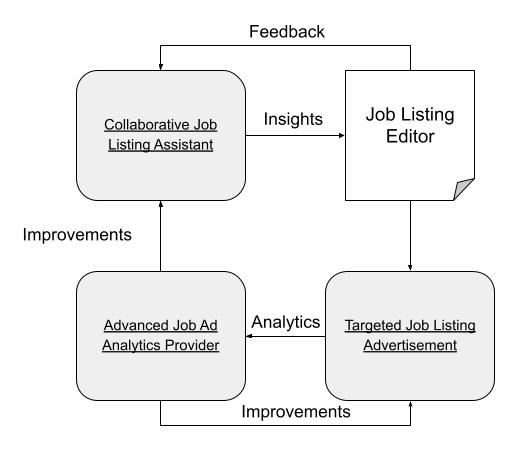
Some of this work can be automated with artificial intelligence. However, using complicated statistical models like deep neural networks to shortcut this process is not only not interpretable, but is also very expensive to train, with training a single model polluting more than five cars throughout their entire lifetimes. Instead, an interpretable assistant is needed to recommend data’s insights and its reasoning, which gets better over time by collaborating with the human user. To implement these ideas, I will create a Collaborative Job Listing Assistant

To post relevant job listings across the web, the traditional approach of duplicating a job listing across multiple job boards requires formatting to different formats required by each board. Then, once posted to each board, it’s difficult to update unless all postings are centrally tracked — requiring a whole other team to manage. Even in that case, though, such a team would not have any guidance for how to update the listings. 

Instead, an approach is needed that can take advantage of a simple job listing format and be posted around the web. To accomplish this, I will use online advertisements as inspiration, with more of a focus on Google search ads than irrelevant banner ads. Given that, the ads will be targeted to people’s actual needs, rather than trying to steal their attention from their current task. 

However, since the ads will be hosted on other websites, additional metadata about the websites will be collected and used to target the job ads. Based on the types of jobs being advertised, other common websites for people in these industries will be used. For example, job ads on Hacker News, Slashdot, or Stack Overflow could be target to software engineers. The resulting component will be called Targeted Job Listing Advertisements.

Using this advertisement system, a solution to track the performance of job listings with actionable metrics seems relatively straightforward. However, listings on job boards usually do not have analytics, at least ones that are actionable. Instead, they more likely provide simple analytics like the number of views, clicks, and applications submitted from your job ad. Such analytics will illustrate a very simple conversion funnel, but nothing more. 

It would be better to know more advanced analytics, such as time spent on a job listing, time spent on other companies’ listings, which ones candidates apply to, and the properties of those listings and companies. Therefore, links in job ads will go to a separate website that tracks these more advanced analytics. The resulting component will be the Advanced Job Ad Analytics Provider, and with it employers will be able to improve their job listings and the advertisements across the web.


I am working on addressing this problem right now. For more information, feel free to email me at bob@datagotchi.net.

Hiring in the Wake of the Pandemic

After the pandemic broke out, upwards of 4.8 million people in California alone lost their jobs. After more than a year of vaccinations and economic reopenings, that number is closer to 600,000 people still unemployed, but many, especially knowledge workers, have decided they don’t want to work for their recent employers anymore. In fact, of those who are still employed, anywhere from one third to 95% of them are considering quitting their jobs. 

Both groups are reluctant to return to work for a variety of reasons, including return-to-work requirements, their ability to find higher-paying jobs, and, for workers like nurses, because their previous job was just too exhausting. Return-to-work requirements are problematic not necessarily because workers dislike working in offices, but because of the commute. A large number of people have left urban areas during the pandemic because they could work from home and didn’t need to commute, or because they want somewhere quieter and less likely to infect them with COVID-19. In addition to opting for higher-paying jobs and the ability to work from home, workers are also likely to look for benefits like educational assistance, unlimited vacation, a home office stipend, and a signing bonus. 

As a result, there are a very large number of unfilled jobs right now — some saying it’s the craziest job market since the 1990s tech boom — and employers are having a hard time hiring for both the positions they laid off during the pandemic as well as for new positions. 

  1. The first reason employers are struggling to fill open positions is that they don’t have a clear idea of what they’re looking for. For example, a few years ago a recruiter we were interviewing told my team his tech company clients were asking him to “just hire good engineers,” and more recently a pizza chain in Alabama stated they will “literally hire anyone.” 
  2. The second reason they are struggling is that employers don’t know where to find candidates. Many job boards exist, but it’s not clear which ones to use. Furthermore, many unemployed people are not actively looking for jobs, and even if they are, they’re most likely using their friends, family, coworkers, and other connections. As a result, some companies are offering up to $50k referral bonuses. 
  3. Finally, the third reason is that employers don’t know what the candidates are looking for. While there are stories, like those mentioned above, that have workers demanding to work from home, seeking higher pay, and benefits, it’s not clear to employers which of these workers would demand, versus which might be added bonuses that could help them differentiate themselves. 

Technical Requirements

Because employers don’t have a clear idea of what they’re looking for, they cannot just create job descriptions like they have in the past. First of all, the pandemic has taught workers that they can demand more than they previously realized, such as the ability to work from home or higher pay. Therefore, well-known job listing best practices may no longer necessarily apply. Also, while looking at other examples online is tempting, those would be from other companies that are possibly in different markets. Therefore, a solution is needed to aggregate recent data with established wisdom to create and edit job listings

Given that employers also don’t know where to find candidates, posting to all available job boards online isn’t sufficient anymore. It can be a lot of work to post to all of the boards, and expensive to hire someone to manage the process. Instead, employers need to find candidates on other websites that they visit. However, it’s unclear what sites are best for a given job. Therefore, a solution is needed to post relevant job listings across the web

Finally, even with a tool to do that, employers don’t know what the candidates are looking for. Rather than hoping for the best with traditional job listings, they could ask people directly or use surveys to see what they’re looking for, but that is expensive and time-consuming. Furthermore, such knowledge would not stay up-to-date as the job market changes, like it didn’t this time around. Employers could also read recent articles and other sources online to learn how the job market is changing, but, like all information on the internet, it’s unclear what take seriously and what to ignore. Finally, such approaches don’t capture what companies candidates end up choose over others, and why. Instead, a solution is needed to track the performance of job listings with actionable metrics.


I am working on addressing this problem right now. For more information, feel free to email me at bob@datagotchi.net.