Uncategorized

A Lifelong Struggle with Reality

From a young age, I have had to find ways to process my frustration when information is presented in a fragmented or confusing manner. In order to avoid overwhelm or even a mental shutdown, I started building tools and processes that help me hold onto coherence, meaning, and safety.

The outline below shows my sensemaking process — how I’ve learned to understand what’s happening externally that enables me to experiment with narratives that better meet my needs, especially after they’ve so often been misunderstood by others. I’m still finding structures for this, but sharing it feels like one way to open the door to conversation.

Datagotchi Sensemaking Methodology

This framework outlines the four-step process of turning personal anxiety and fragmented information into a clarified, actionable understanding of the world.

  1. The Triggering Event: The initial moment of dissonance or chaos because your reality and external reality do not align.
  2. Externalization: The act of turning internal, chaotic thoughts and feelings into a concrete, external document or system so as to not forget and reference again in the future.
  3. Causal Analysis: The process of connecting the dots and revealing the underlying system at play. It’s where you find the causes of the original triggering event.
  4. Collective Action: The application of your newfound understanding through sensemaking for a greater purpose. Your personal insight becomes a building block for the collective.

Does this process resonate with how you make sense of things? What does your own version of sense-making look like?

This framework was born from a personal struggle to make sense of a fragmented world. You can read the full story of my journey and the philosophy behind my social impact research lab (Datagotchi Labs) here: https://datagotchi.net/2025/08/28/from-personal-struggle-to-collective-rebellion-the-why-behind-datagotchi-labs/.

From Personal Struggle to Collective Rebellion: The Why Behind Datagotchi Labs

From Personal Struggle to Collective Rebellion: The Why Behind Datagotchi Labs

Datagotchi Labs is a rebellion. While our mission was born from a deeply personal struggle—my lifelong journey to make sense of a fragmented and overwhelming world—it has evolved into something more. My personal path has now become our moral mission: to build a new digital economy that empowers people with information to increase their clarity, empathy, and solidarity.

This is the story of how my personal need became the foundation of a neurodivergent rebellion.

The Problem, From the Inside Out

For years, I grappled with mental and emotional states that are a direct response to infant trauma. This internal struggle created a profound sense of powerlessness—a feeling that the world was chaotic and unpredictable, and I was just a passive observer. It manifested as chronic anxiety, which often felt like a crushing information overload that left me in a constant state of fight-or-flight. My lack of trust and disinterest in socializing stemmed from an inability to feel truly safe—a feeling that manifested as a profound sense of being a “perpetual outsider” who was constantly freaked out by that confusion.

This personal, neurodivergent struggle is the microcosm of a much larger societal problem. Today, the average person is a passive consumer in a digital economy that preys on this exact same sense of confusion and isolation. The Digital Oligarchy—a small elite who seized control of platforms after 2008—extracts “rent” from us by feeding us fragmented, filtered, and manipulated information. The result is widespread digital fatigue, a sense of disempowerment, and, ultimately, a broken collective will. Social problems are experienced as individual burdens, making collective action nearly impossible.

This is the very same problem I’ve been fighting my entire life, just on a grander scale. I’ve realized that I am not just a software developer or a founder; I am a neurodivergent integrator. My entire life has been a journey of synthesizing fragmented information from different disciplines and connecting the dots that others miss.

The Digital Oligarchy’s Biggest Lie: The False Promise of Meritocracy

The Digital Oligarchy and its followers—e.g., venture capitalists and their funded startups—echo these lies, because they are selling a vision, not a reality. We, on the other hand, are “pulling back the curtain” on the whole show. We’re here to reveal the truth and show what is real. That truth is that meritocracy is a myth—the lie that our success is a direct result of our individual talent and effort, and that our failure is entirely our own fault. The current billionaires in our society got their money and connections from their parents! It’s a narrative that keeps us from questioning the system itself.

They use the very tools of technology to lie to us, promising individual freedom while deliberately breaking our collective will. They feed us a constant stream of fragmented information, turning our lives into a frantic attempt to grab a piece of the truth—the same way the blind men in the ancient parable tried to describe an elephant based only on the part they could touch. One feels the trunk and says it’s like a snake; another feels the leg and says it’s a tree. No one can see the whole elephant.

Our Solution: A New Digital Economy

Instead of fighting the Digital Oligarchy on their own terms, we will build a new digital economy from the ground up. Our mission is to empower a new class of rebels to reclaim the information commons—the original vision of an open, decentralized internet—and inspire collective solidarity. We’re doing this with a phased roadmap that leverages the very technology that was used to exploit us.

Phase 1: Empower the Rebels Our core product, Inspect, is the foundational tool for this rebellion. It’s a distributed, peer-to-peer tool for verifiable truth. Inspect is a free, open-source tool available on platforms like GitHub. It empowers Insight Authors (independent journalists and activists) to:

  • Create Insights: Connect disparate information into valuable insights, revealing that many problems are systemic, not personal failings.
  • Collaborate on Insights: Share and build upon these insights to create a shared, collective understanding—the foundation of solidarity.

Phase 2: Empower the Vassals & Build the Commons In the feudal system, serfs paid tribute to their lords. Today, the Digital Oligarchy acts as the new lords. Once we’ve proven our model with the rebels, we will expand our mission to empower businesses and brands—the new vassals—that are currently paying tribute to the Digital Oligarchy. We will help them reclaim their data and build new, more direct relationships with their customers.

The Tools of the Rebellion, Born from a Personal Need

Every one of our products is a direct answer to a personal problem I’ve faced:

  • Inspect: This is the ultimate expression of my personal mission. Starting as a mobile app to share news articles with friends and family members, it’s now a broader tool to transform confusing, fragmented information into clear, verifiable insights. It’s a direct solution to that profound feeling of being overwhelmed and disconnected from a world that doesn’t seem to make sense.
  • PMBoard: Born from my consulting experience for technology companies, PMBoard was created to manage the overwhelming, fragmented demands of product stakeholders. It mirrors my personal need to organize and unify complex information.
  • Collaborative Copilot: This tool is an extension of my core need to synthesize diverse perspectives into a single, cohesive narrative. It’s a system for integrating automation and data-driven tools like AI, designed to bridge the gap between individual understanding and a shared, collective understanding, allowing teams to move from fragmented ideas to unified action.
  • Counteroffer: This project was born from my frustrating experience in a broken job market. It reflects my desire to empower others and restore a sense of control in a system that deliberately disempowers you.

Our Uncompromising Moral Compass

Our business model is a direct extension of our mission. Our core product, Inspect, is free. The revenue from our spinoff projects funds the rebellion, ensuring we can build a more humane digital future without compromising our values.

This approach is guided by a hybrid moral framework that is both rule-based and practical, grounded in universal principles while remaining responsive to the unique details of each community. It’s a commitment to act with prudence, always seeking to do the greatest good for the most people, in a way that respects the dignity of every individual and is grounded in the lived experiences of our users.

This is more than just a company; it’s an authentic rebellion. It’s a belief that our collective well-being is not a byproduct of the system, but its very foundation. We will use the very tools of technology to organize outside the system, build our own parallel institutions, and create a more equitable future.

Counteroffer: A Public Forum for Improved Candidate-Job Listing Fitness

Problem Space

These days, a new cultural dynamic has emerged between job candidates and recruiters. During the COVID-19 pandemic, many candidates took part in the Great Resignation and quit their jobs to find something better, and, as the pandemic issues reduced over time, candidates started making more demands like working remotely and an improvement in company culture. However, as the pandemic lessened, recruiters have started making more demands, too, like requiring employees to come back to the office. As a result, the candidate-recruiter dynamic of making offers and counteroffers has returned and has taken the form of both sides again having high-but-competing hiring expectations.

Both job candidates and recruiters are still struggling with connecting with one another, too. On one hand, both are overloaded with the number of job opportunities and candidates on the internet, and, on the other hand, both struggle with finding the right job opportunities and candidates. The latter issue is partly because the right fit might not be even posted on the internet, and, if it is, there are limitations in reaching it. For candidates, this takes the form of applicant tracking systems (ATSs) that automatically scan their resume for specific keywords that aren’t necessarily even on the job listing. For recruiters, this takes the form of having to screen and filter through hundreds of applications for a job and trying to control their conscious and unconscious biases when doing so, such as choosing a candidate based on a specific past employer or their name. Therefore, both parties need improved searching and filtering capabilities

Throughout the past five years, job candidates have tried many ways and converged to their favored ways to look for jobs, either through personal connections if they are so fortunate, specific online communities, or even search engines. Regardless of their method, they still struggle with a lack of feedback on their applications. Similarly, almost all recruiters are doing hiring online now, so they already have chosen tools like ATSs, but they keep struggling with data management and ensuring their compliance with regulations while trying to ensure a good experience for candidates. For both parties, these issues arise due to the time-consuming application process and can be made even worse by technological glitches during the process. Therefore, they both have the need to make the hiring process go more smoothly. Furthermore, both have needs for added security. Candidates cannot easily present their credentials or verify job listings, and they may have concerns about sharing information online, and recruiters cannot easily check a candidate’s references, and both may struggle with language barriers. Therefore, candidates and recruiters need an efficient and secure way to exchange information during the hiring process.

Technical Requirements

Because both job candidates and recruiters again have high-but-competing hiring expectations, there needs to be a way for both of them to explicitly outline these expectations. The current approach to this involves phone calls and zoom meetings, but these are not recorded, and, even if they were, they would have to be processed manually—or, if by automation or crowdsourced to people in a third world country, the transcription would still need to be fixed manually. Therefore, these interactions should be based on text. For candidates’ requirements, this means including it on or adjacent to their resume, and for recruiters’ requirements, it means including them in job listings. Then, candidates will need the ability to tag their resume with job listing requirements before or when applying to the job, and recruiters will need the ability to answer to candidate requirements and save the answers for the business’s records. Therefore, a solution is needed to enable taggable and savable requirements document interactions. 

Even though job candidates and recruiters also need improved searching and filtering capabilities, most modern search systems are based on keywords or n-grams (a series of keywords in the same order). Instead, also search for synonyms and frequently-used-together keywords—fuzzy searching—is needed. Similarly, fuzzy filtering based on candidate-job listing fitness is also needed instead of direct keyword matching. Because the previous component will make job listings and resumes use tags, searching and filtering will not need to create new tags. However, results of the searching and filtering will need to be savable for future reference and sharing with others. Together, that means a solution is needed to enable fuzzy tag search and fitness filtering with savable results

To help job candidates and recruiters use an efficient and secure way to exchange information during the hiring process, existing chat tools need to be enhanced significantly. First, most are not secured end-to-end largely because some third party in the process wants access to the data, and this is a data security requirement for both candidates (for their sensitive portfolio materials) and recruiters (for their business data). Second, existing chat systems do not enable saving information once you get it from the other party. They do usually support copying text and pasting it elsewhere, but this is a very manual process that does not necessarily capture the information in its desired. Therefore, such a system must enable tagging information entities by the sender and saving this information to third-party systems. Together, a solution is needed to enable taggable and savable E2E-encrypted chat

Our Solution

For our solution to enable taggable and savable requirements document interactions, how to tag and save the documents need to be decided. To tag the documents, having the creator highlight text and choose to tag it seems the most straightforward. However, how to save the tags locally and how to present them to the other party are not straightforward. Ultimately, our solution will save them in a database, but this database will not be publicly available. So, we will use a markup language as a solution to saving them locally, transferring them, and rendering them locally by the other party. That enables copying text that contains tags and using them elsewhere if desired.

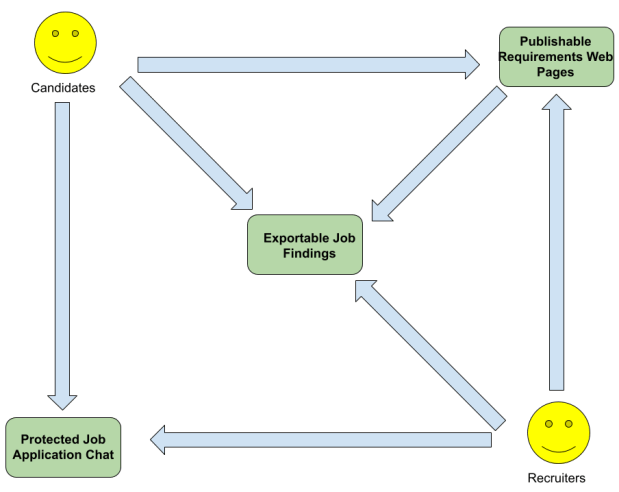
For candidates, these documents will be surveys for recruiters to fill out to see if they can satisfy the candidate’s requirements, along with their resume. When recruiters supply answers, they will be stored in our solution for the candidate to list and compare multiple job opportunities, and both will be stored in our solution for the recruiter and can be sent to ATSs to track applications to this job. 

For recruiters, these documents will be job listings for candidates’ resumes to match the job requirements. They will be saved in our solution and exportable to other job boards. When applying, candidates can rearrange their resume sections and add tags from the job listing requirements. Then, the resumes will be stored in our solution for candidates to reuse and also to export to PDF to apply to jobs outside of our solution, and again in our solution for recruiters and to be exportable to ATSs.

The resulting components will be called Publishable Requirements Web Pages with the same text tagging, saving, and exporting features features, and the ability for creators to start with drafts and publish them when desired. These will be accomplished with making them high-quality HTML documents, partly for the public search feature mentioned below. Also, both will have user- or organization-editable standards to show in the UIs so certain standards will not be forgotten. For candidates, these standards might include best practices in their domain, and for recruiters this might be business standards or metrics, and the fact that keywords used by your ATS should be included in the job listing. On this standards display, eventually some technological automation will also be added to suggest requirements from the users’ past documents and perhaps other public documents on the web. 

For our solution to enable fuzzy tag search and fitness filtering with savable results, how we implement fuzzy search and filtering, as well as saving, need to be determined. For fuzzy search, we will start with using Google’s tool (https://programmablesearchengine.google.com/about/) that lets you put their search engine on your website. This means that the resumes with surveys, and the job listings, will be searched on the public web, which is acceptable because they have been explicitly published by their authors. Filtering search results is a different matter because those search results will be updated by incrementally-changed filters, and they are private to the searcher. Therefore, we will use one of the many fuzzy matching libraries based on the results from the Google search. For recruiters, we will use the job listing requirements as possible filters, thus making the filtering based on candidate-job listing fitness and acting as a sort of standards that the recruiter should use to filter on. For candidates, we will save filters they used from other job opportunities so they can be listed and compared to each other to decide on which ones they prefer. For saving, search queries and filters wille be saved in our solution, of course, making the searches a sort of draft being saved by the user. Then, the search and filter results will also be exportable to external systems. The resulting component will be Exportable Job Findings

For our solution to enable taggable and savable E2E-encrypted chat, the tagging and saving will use similar or the same code as our other components. Specifically, survey answers and job applications will be stored in the E2E chat and thus not be publicly searchable, but will be copy-and-pasteable, and the tags will be saved to our solution and exportable to external sources. Like the components above, standards will be listed adjacent to the chat to remind users about business metrics, government compliance, and professional manners, which for this third component will also include reminding recruiters to give feedback to candidates after they have evaluated their applications. Eventually, automation may be added to use the saved chat tags to evaluate the success of the job listing for the recruiter and the success of a resume for the candidate across job listings. 
The E2E chat will be provided by the Signal messaging application because it is the world’s best chat platform that is, it is open source, and it always will be E2E encrypted. It is also created and maintained by the Signal Foundation, a non-profit with the mission to “protect free expression and enable secure global communication through open source privacy technology.” Together, this solution component will be called Protected Job Application Chat.

Why Startups Need Problem-Solution Fit

To hire, test out product features, and grow, startups need money before they start making profits—they need investment. Investors want to have confidence that a startup they invest in will be able to grow enough so that they get a return on their investment. As a result, a concept was established called product-market fit, which is when a startup’s product is useful to one or more customer market segments and competes effectively with other products in that space. 

However, most startups are not able to achieve product-market fit. There are several reasons for this, but a key aspect of it is that their product does not does not serve the needs of any potential customers. In other words, their product does not solve an actual problem. A term to describe this problem is not having problem-solution fit. This is a bit misleading for products that offer novel interactions rather than solving a problem, but it could be said that not being able to interact with people as much, or as effectively, is the problem such products are solving. 

Therefore, all startups must reach problem-solution fit.

To do so, they need to empathize with users and/or customers in order to understand what they are thinking and feeling, both in their existing work and with a startup’s new product. This can be done with easy or “lean” methods like signup forms on landing pages or created content on blog sites like Medium. Then, if these methods show some promise, more serious or formal research can be done to confirm that they have a problem that a startup’s solution addresses, and then that a large enough number of them have this problem for similar reasons. The first step in formal user/customer research can be done by observing people doing their jobs and interviewing them, while the second step can be done with online surveys or focus groups.

Then, after identifying some potential users that the product solves a problem of theirs, a startup should find a subset of them or their managers that are willing to pay for it (customers). This is the first step toward achieving product-market fit.

Research Consulting Proposal

Problem Space

To hire, test out product features, and grow, startups need money before they start making profits—they need investment. Investors want to have confidence that a startup they invest in will be able to grow enough so that they get a return on their investment. As a result, a concept was established called product-market fit, which is when a startup’s product is useful to one or more customer market segments and competes effectively with other products in that space.

However, most startups are not able to achieve product-market fit. There are several reasons for this, but a key aspect of it is that their product does not does not serve the needs of any potential customers. In other words, their product does not solve an actual problem. A term to describe this problem is not having problem-solution fit. This is a bit misleading for products that offer novel interactions rather than solving a problem, but it could be said that not being able to interact with people as much, or as effectively, is the problem such products are solving.

Therefore, startups must reach problem-solution fit. Then, after identifying some potential users that the product solves a problem of theirs, a startup should find a subset of them or their managers that are willing to pay for it (customers). This is the first step toward achieving product-market fit. In other words, to achieve product-market fit, a startup must first identify customers that are willing to pay for their product.

Finally, after achieving product-market fit, a startup must grow so that they can acquire enough dominance in the market space to attract acquiring companies or file an initial offering to become a publicly-traded company (i.e., an initial public offering, or “to IPO”).

Technical Requirements

To reach problem-solution fit, or to make sure you build something that people actually want or need, many startups think of something that they would want or need, or use their gut instinct. However, such approaches, while a good start, are prone to error. At the very least, startups should test their solution’s core value proposition–the benefit that it provides to users and customers. This can be done with signup forms on landing pages or created content. Then, possibly using the potential users and customers from these tests, some iterative user or customer research is necessary to continuously confirm that they have a problem that your product solves, and that a large enough number of them have this problem for similar reasons.

To reach product-market fit, or to make sure your product is useful to one or more customer market segments and competes effectively with other products in that space, a startup must start by determining who are users and who are customers. They may be the same people, the customers may be managers of users of your product, or the customers may be organizations running ads to the users. Then a startup needs to understand users’ and customers’ needs to understand what product space they’re in and how to compete in it. Again, while subjective

views and gut instincts are a start, something more formal is needed to identify go-to-market opportunities and verify they would serve a large number of people or organizations. The tests ran to reach problem-solution fit are also helpful because they may contain information about users’ and customers’ needs, or because they may provide a list of people for user or customer research.

Finally, to grow, or to acquire enough dominance in the market space, a startup must optimize their successes delivering their product to users and customers and their success using it. Therefore, it is necessary for a startup to identify one or more channels to reach users or customers and deliver their product to them. Once the channels are identified, marketing funnels should be created for each of them, with potential users or customers and leads at the beginning, and prospects in the middle, and successful users or customers at the end. To increase the success between these funnel stages, a startup must iterate on their product and user or customer research to confirm their needs and success using it.

My Solution

The concepts of user experience (UX), human-computer interaction (HCI), and usability testing all have foundations from when a group of researchers in 1982 came up with the concept of cognitive systems engineering (CSE) in response to the Three Mile Island nuclear disaster of 1979. It was then formalized by a couple of those researchers in 1983 with the lens of people and machines working together as a joint cognitive system (JCS). With this lens, CSE became an approach to systems engineering to continuously verify one’s understanding of users and machines, their joint success or failures in operation, and how those failures can be addressed. A similar cyclical approach called human-systems integration (HSI) was also invented in the military to model each systems engineering iteration’s decisions as risk management. I have worked with both the researchers that invented these approaches, and their followers, in my past government R&D research scientist jobs.

While usability, HCI, UX, design thinking, and so on, are used in the world of tech startups, other concepts of CSE like JCS and the HSI iterative cycle of systems engineering have not made their way there yet. Therefore, I will use my knowledge of these methodologies and related processes and tools to help startups with user and customer research, and improving their products with that knowledge–iteratively throughout their product lifecycles.

Problem-Solution Fit

To help startups perform user research to achieve problem-solution fit, I will study users’ and customers’ problems and their environments that are relevant to the envisioned product. Including their environments is necessary because their problems do not exist in a vacuum: they exist because of other factors or constraints in their job or life, and cannot be addressed without addressing those factors, too. Since people’s activities in their lives may or may not fit a consistent schema, I will start by creating empathy maps on potential users and customers. These will involve what they say, think, do, and feel, and possibly what they see and hear.

Then, as I learn more about them, I will add structure to the empathy maps. While a common formalization of empathy maps is personas, which are fictional people that have the attributes documented in empathy maps, I will take inspiration from cognitive work analysis (CWA) when it is possible. CWA maps a worker’s tasks and activities to the goals that they help achieve and the worker’s overall objectives that they are trying to fulfill. CWAs are a powerful CSE tool because they capture a worker’s job in its current state, which help identify inefficiencies that can be addressed with a product, and they can be extended with features of a product to test its success. They can also be combined with personal details to create personas.

Also, although CWA is taken from work-centered CSE research, it can be applied to consumers–i.e., people using a startup’s product outside the context of work. In these cases, overall goals may be social connections, self-worth, or similar ideas, and goals and activities may involve going out with friends or posting on social media, for example.

To enumerate empathy map metrics, potential users can be interviewed and they can be observed doing their job using their existing tools. Together, these methods will identify their job’s overall objectives, the goals to achieve these objectives, and the activities used to achieve these goals. Job observation will then identify the specific tasks taken during these activities and the tools and constraints that affects their execution of tasks. Finally, surveys or focus groups can then be used to discover if these metrics are common among a larger set of potential users.

Once these metrics are discovered, they can be measured, and then bottlenecks or other problems can be identified. These are the opportunities for a new product. To evaluate the empathy map metrics, specific measures must be identified and job observation is needed to record the values of the measures. Similar to empathy map metric enumeration, surveys or focus groups can then be used to discover if these bottlenecks or other problems are common among a larger set of potential users or customers.

Finally, solution improvements can be made to improve these metrics, and the cycle repeats.

Product-Market Fit

To help startups perform user and customer research to achieve product-market fit, I will study previously-identified user’s workflows and customers’ needs. Empathy maps and CWAs may identify some tasks that are part of a user’s activities, but it is not focused on the structure of these activities and tasks. Therefore, I will start by creating user journeys, which are diagrams of the tasks or steps a user goes through while using the product.

Then, as I learn more about them, I will add more details to the user journeys by taking inspiration from cognitive task analysis (CTA). CTAs map tasks and activities to their cognitive states (e.g., goals that the user is trying to achieve with them). Although CTAs are taken from work-centered, CSE research, they can be applied to consumers–i.e., people using a startup’s product outside the context of work–in that, like CWAs above, the goals that the activities and tasks help achieve may be social or personal goals.

For highly structured jobs, and easily-observable tool usage, job observation can be used by itself. For more unstructured jobs, or for tasks that are more difficult to observe, methods like card sorting can be used, where a potential user sorts labeled cards about information, tools, or tasks they can perform to determine the order they prefer to achieve a goal identified in the CWA.

Then, go-to-market strategies and metrics to evaluate them should be identified. In the case of users being the customers, or users being the product to the customers (e.g., attention and data for advertisers), marketing funnels for the identified delivery channels can be extended, or supplemented, with product usage funnels from journeys that are modified with features of a startup’s product. Then, these funnels can be evaluated with analytics events embedded in the product, and user journeys can be evaluated with those analytics.

The customers’ needs also need to be understood, regardless of whether or not they are the same as the user. As a start, customers can be interviewed and documented with empathy maps. Then, workers’ objectives that were identified in the empathy maps can be mapped to their managers’ goals. Also, similar to user journeys, customer journeys can also be evaluated with job observation, interviews, card sorting, or analytics, along four stages (AIDA):

  • Their Attention to or Awareness of a product category or the product itself is increased: Advertisements, created content, etc., can be tracked in terms of the number of views they get and the percentage of interactions they get (e.g., click-through, CTR, of ads).
  • Their Interest in the product is increased: Starting with the percentage of interactions, other activities related to ads or content can be measured and combined to score how much a lead is interested in the product.
  • Their Desire of the product is expressed: Similar to interest, desire can be measured by more direct activity like downloading a product (if applicable), signing up to get notified when it launches, and so on.
  • They take one or more Actions: For example, shopping around the product category, trying out the product, or buying the product. Having a certain number of large/popular companies as customers is often used to measure pm-fit, but startups can go further. Measuring product-market fit, both to optimize internally at the startup or for future investors can be done by doing cohort analysis on the metrics mentioned above — i.e., what percentage of people from a previous stage go to the next stage, all the way to buying the product. On the way to reaching product-market fit, a startup should make product improvements to improve these customer and user metrics.

Growth

To help startups grow, I will assist with the use of analytics to help iterate on product features to optimize key metrics–a process often called growth hacking. Analytics will be used for two purposes: to identify differences in users’ or customers’ patterns with a product versus the modified, envisioned journeys mentioned above, and bottlenecks in funnels with the end stages resulting in money for the startup. A common approach to grouping these metrics is “the pirate metrics”: acquisition, activation, retention, referral, and revenue (AARRR, like pirates say).

Existing analytics solutions can be used (e.g., Mixpanel, Heap, Segment), or a custom analytics solution can be created. Then, funnel events need to be inserted into the product to fire off when users take certain actions. Finally, the funnels should be visualized with aggregated data across users.

If the users’ or customers’ patterns do not match the envisioned journeys, then interviews can be done to identify reasons for the differences. Similarly, interviews can be done to identify reasons for bottlenecks in funnels that *do* match the journeys, but do not complete them. Then surveys and focus groups can be used to determine if these reasons are common.

Finally, changes to the product can be made to improve the analytics, and the cycle repeats.
NSF Seedfund pitch for Illuminate by Datagotchi Labs

Technology Innovation

Many frame the primary problem with artificial intelligence (AI) systems as users not trusting them, or as the AI systems not being trustworthy. However, automated technologies have always been a problem because they are not resilient in the face of unforeseen circumstances. In other words, AI systems are not trustworthy because they are unhelpful for data they are not trained on.

One solution to make these AI systems more resilient is to show where their outputs came from, and, if it is unable to provide a high-quality answer, why it was not trained on relevant data. However, many modern AI systems are based on deep neural networks. Therefore, they cannot practically show the path through their network that resulted in an output because they are billions or trillions of parameters large.

(1) To be resilient in the face of unforeseen circumstances, AI systems must show rationale that users can understand and react to when the systems fail, rather than just forcing users to recall them or assume that the system is always right. Therefore, our high-risk technology innovation will be a Collaborative Copilot that uses interpretable models. This is high risk because interpretable models often do not scale well with data, are not easy to develop like deep neural networks these days due to the tools from tech giants, and are expensive to train.

For interpretable models, linear rules would only be accurate for a very niche domain of data. Their extension into decision trees would not be easy to use because they cannot be automatically pruned. Bayesian networks would have similar problems, so we will use Causal Influence Models (CIMs). CIMs are Bayesian network UIs with connections going in the direction of influence and have colors and weighted lines to show the influence sign and strength.

Although relatively easy to understand, forcing users to read through full CIMs would still result in significant cognitive overload.

(2) To minimize cognitive overload, information system UIs must fit users’ mental states when they are doing work. To explicitly consider users’ mental states, they should be objectively modeled, rather than just guessed by the developers or inferred from biased surveys of users. Therefore, we will supplement the Collaborative Copilot development by designing and empirically evaluating Mixed-Initiative Workflows using a family of research methods called Cognitive Task Analysis (CTA). However, CTA models of users may not match users in the real world, nor do they capture the higher-level objectives and constraints of their work. Therefore, we will also measure the professional contexts of users using a family of research methods called Cognitive Work Analysis (CWA), which outline the objectives and goals of the users and map them to their activities and tasks.

Technical Objectives and Challenges

1. Prototype and Evaluate the Collaborative Copilot

We will build interpretable models with Python tools like Pandas, NumPy, SciKit-learn, and Matplotlib, and will compare our models to deep neural networks created with tools like TensorFlow and PyTorch. We will evaluate these models and compare them with deep neural networks on four metrics:

  1. High output quality: We will start with accuracy and machine learning variations on it like the receiver operating characteristic (ROC) and area under the ROC curve. Deep neural networks are famous for being very high quality, so this will be our primary metric.
  2. Understandability of outputs: We will verify that users can understand the machine’s output and determine if they are mistaken. We will do this by comparing users’ mental states with the Copilot’s models.
  3. Ease of development: Because interpretable models do not train and scale with backpropagation like neural networks, more technical expertise is likely required. We will specifically consider the technical expertise needed to run expectation maximization (EM) training on the networks.
  4. Training costs: Large corporations have the resources to build deep neural networks with large amounts of data, while smaller businesses and academia often do not. Therefore, we will explicitly measure the costs for the EM training. For expensive cases, we will consider incremental learning, where they can start out as linear rules, then become networks of rules, and finally become Bayesian networks.

2. Design and Evaluate Mixed-Initiative Interaction Workflows

We will design these workflows with mixed-initiative interaction: utilizing software to process data, generate models, and make suggestions to the user, and enabling users to not only request suggestions when they need them, but to also critique them when they are confusing or mistaken.

The workflows will be evaluated in two ways: (1) by matching the states of the users during tasks to the system’s output: to ensure that users understand the machine’s outputs, and (2) the performance of users and the software accomplishing the tasks together: to ensure that users can correct or take over for the system when necessary to increase resilience.

3. Validate Commercial Viability and Impact

In the Phase II, we will apply the innovations to a use case we have researched over the past few years: reducing information asymmetries between job candidates and recruiters to improve the efficiency of hiring. Therefore, in Phase I, we will work with user representatives from our previous research and development to confirm their commercial viability and impact.

Market Opportunity

  • Models: To ensure general use of the models we develop by individuals, they need to always be free. Furthermore, to enable academic research of them and both individual and commercial modification of them for different uses, they should be open source. However, we could offer support services for them to businesses.
  • Mixed-Initiative Workflows: The mixed-initiative workflows would likely be exposed via research papers, and thus would be de facto free and open source. However, for commercial usage, they could also be patented and licensed.
  • Candidate and Recruiter Tools: The candidate tools were always envisioned to be free to ensure high adoption. Furthermore, since the initial target users were senior software engineers, they could also be open source to enable customizations and improvements. The recruiter tools, on the other hand, are the primary market opportunity for Phase II’s use case. Whether the users are external or internal recruiters, they likely have a budget they can use to pay us.

Company and Team

  • Founder: I have a diverse background in technology and data science. I have a BS in Computer Science, and an MS in Information Science. I researched AI throughout undergrad and grad school. After grad school, I was hired in the government R&D field as a decision-support analytics research scientist and software engineer. I wrote SBIR and STTR proposals on human-machine collaboration and mixed-initiative interfaces, won many of them, and led the resulting projects. In other words, I have focused my entire career on these types of problems. I have also collaborated with many of the relevant researchers who have championed resilience engineering, cognitive task analysis, and cognitive agent rationale, and who would likely be happy to consult for this project. I then moved to California and have worked with several technology startups as a full-stack engineer, UX expert, and product manager.
  • Company Background and Status: Datagotchi Labs is an R&D lab I’m incubating to use the skills I’ve gained in my career. I have explored several ways to make money, starting with a Patreon page, spinning off this project to raise investments, and running Kickstarters for the consumer-side of the projects. Since none of these have been successful, in addition to pitching to the NSF Seedfund, I am currently working on a marketing campaign to better establish myself on social media to attract some consulting leads and offer freelancing services.

Datagotchi Labs: Empowering People with Information

Our economy is based largely on exploiting both natural resources and people for profit without regard to how it affects either the earth or those people. To protect themselves, those in power hide as much information they can about what they are doing. For example, corporate reporting structures are designed to keep lower-level employees ignorant of what executives are doing with their company. Similarly, news website paywalls keep people from knowing important information, even if it affects our democracy! When information is available to people, it is often distorted with complete or partial lies. Failing that, useless information is often used to distract people from important truths.

Many people in the world are working on solutions to these problems. For example, there are people working on data visualizations, which are better than raw, tabular data, but often do not have the necessary context to make them useful. There are many working on investigative journalism to get important information out to people, but these efforts do not decrease the amount of information that is overloading people. As a result, some people have resorted to protests to get out the word on information they think is important. However, this is still dangerous in our democracy because those in power will find ways to disenfranchise them by firing them from their jobs or even arresting them. Most importantly, none of these efforts are focused on enabling people to use the information once they get it.

Instead, people need to be empowered with information. That means giving it to them in the contexts where they can use it. For example, company information would be helpful when deciding whether or not to join or stay at a company; news about global warming would be more useful with tips on what to do about it; and information on a product’s supply chain is useful when deciding whether or not to buy it.

However, while such contextualized information can empower some people, it may not empower people who are not in those contexts. For example, an employee who can’t leave their job because they are in debt would not find the extra company information useful; most people are disenfranchised when it comes to making global warming mitigation policies; and many consumers need lower-priced products so they don’t break their budgets, rather than more moral products.

In other words, people need to be empowered with information in way way that guarantees that it is useful in some way. Even if they can’t directly use it, like information in a representative democracy, they deserve to know it because it affects their lives. Therefore, for the examples above, company information, global warming news and suggestions, and product supply chain information should be easily available — not just upon demand, but to others who may not think to make the demand.

Therefore, I am officially launching my initiative, Datagotchi Labs, to truly democratize information. This means that my products will be focused on this goal, and will always be free for people to use. Requiring them to pay for these capabilities goes against my motivation for creating the products in the first place. It also means that the products’ creation and improvement will be collaborative with any and all people who are interested in participating. While I have a couple of products already in their early stages, I plan to include interested people more in the creation of future products. In the meantime, I plan to involve everyone in the testing and improvement of the Inspect and Counteroffer products once I launch them.

Since I am now devoting myself to incubating Datagotchi Labs full-time, collaboration will start in the form of a Patreon page, where members can pledge a monthly donation to me (starting at $5/month) in exchange for updates, involvement, and early access to my work.

Even if you can’t afford $5/month, though, I would still like to invite everyone to the Discord channel to chat about products Datagotchi is currently working on, and can work on in the future! Find it here.

For further reading